



- CAS
- Purity
- 91-81-6
- 99%

Location:Home > Pharmaceutical
|
Manufacturing Process |
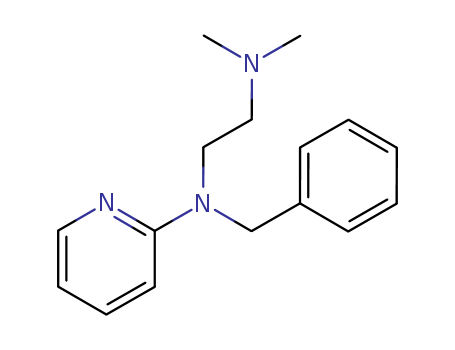
46 g of α-benzylaminopyridine in 50 cc of dry toluene are heated to 80°C [the α-benzylaminopyridine may be obtained either according to the method of Tchitchibabine and Knunjanz, Berichte, 64, 2839 (1931), which consists in warming α-aminopyridine with benzaldehyde in formic acid, or alternatively by the action of benzyl chloride on sodio-α-aminopyridine]. To the toluene solution there are added gradually 9.5 g of 85% sodamide. After evolution of ammonia, the major part of the toluene is distilled off; into the pasty mass which remains there are poured 120 cc of an ethereal solution of 27 g of dimethylaminochloroethane. The mixture is heated until the temperature reaches 140°C, the ether distilling out, then finally heated under reduced pressure (150 mm Hg) for 1/2 hour. The mass is taken up with dilute hydrochloric acid and ether, neutralized at pH 7, and α-benzylaminopyridine separates. After making alkaline, using excess of potash, it is extracted with benzene, dried and distilled. The product thereby obtained, dimethylamino-ethyl-N-benzyl-N-α-arninopyridine, boils at 135° to 190°C/1.7 mm, according to US Patent 2,502,151. |
|
Therapeutic Function |
Antihistaminic |
|
Reactivity Profile |
Tripelennamine neutralizes acids in exothermic reactions to form salts plus water. May be incompatible with isocyanates, halogenated organics, peroxides, phenols (acidic), epoxides, anhydrides, and acid halides. Flammable gaseous hydrogen may be generated in combination with strong reducing agents, such as hydrides. |
|
Health Hazard |
SYMPTOMS: Symptoms of exposure to Tripelennamine may include euphoria, aplastic anemia, excitement, hallucinations, ataxia, incoordination, athetosis, convulsions, postictal depression, dry mouth, fixed dilated pupils, flushing of the face, fever, central nervous system depression, drowsiness and coma. |
|
Fire Hazard |
Flash point data for Tripelennamine are not available. Tripelennamine is probably combustible. |
|
Safety Profile |
Poison by ingestion and intraperitoneal routes. Human mutation data reported. Has been implicated in aplastic anemia. Used as an antdustasnine. Addicts have added it to paregoric to make "blue velvet," whtch can cause euphoria by injection. When heated to decomposition it emits toxic fumes of NOx. |
|
Synthesis |
Tripelennamine, N-benzyl-N′,N′-dimethyl-N-2-pyridylethylenediamine (16.1.6), is synthesized by reacting 2-benzylaminopyrridine (16.1.5) with 2-dimethylaminoethylchloride in the presence of sodium amide. 2-Benzylaminopyrridine, in turn, can be easily synthesized by reduction of a Schiff base, synthesized by condensation of 2-aminopyrridine with benzaldehyde. |
|
Metabolic pathway |
When pyribenzamine is incubated with rat liver microsomes, it is metabolized via N-oxide formation and N-dealkylation which includes removal of the dimethylamino moiety, the thiophenylmethyl moiety of methaphenilene, and the benzyl moiety of pyribenzamine. |
InChI:InChI=1S/C16H21N3/c1-18(2)12-13-19(16-10-6-7-11-17-16)14-15-8-4-3-5-9-15/h3-11H,12-14H2,1-2H3
A nickel-catalyzed intramolecular C - N ...
The amination of various phosphorodiamid...
Focal adhesion kinase (FAK) and vascular...
The alkylation of amines by alcohols has...
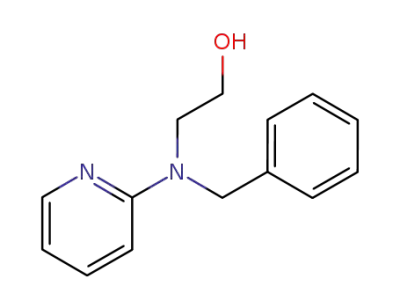
2-(N-benzyl-pyridin-2-yl-amino)ethanol


dimethyl amine


tripelennamine
| Conditions | Yield |
|---|---|
|
With
[ruthenium(II)(η6-1-methyl-4-isopropyl-benzene)(chloride)(μ-chloride)]2; bis[2-(diphenylphosphino)phenyl] ether;
In
toluene;
at 20 ℃;
Inert atmosphere;
Reflux;
|
75%
|
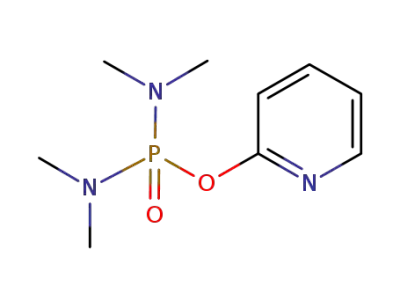
pyridin-2-yl N,N,N',N'-tetramethyldiamidophosphate

N,N-dimethyl-N'-benzyl-1,2-ethanediamine
tripelennamine
| Conditions | Yield |
|---|---|
|
With
TurboGrignard;
In
tetrahydrofuran;
at 0 - 25 ℃;
for 8h;
Inert atmosphere;
|
74%
|
2-(N-benzyl-pyridin-2-yl-amino)ethanol
dimethyl amine

2-chloropyridine

N,N-dimethyl-N'-(pyridine-2-yl)ethane-1,2-diamine
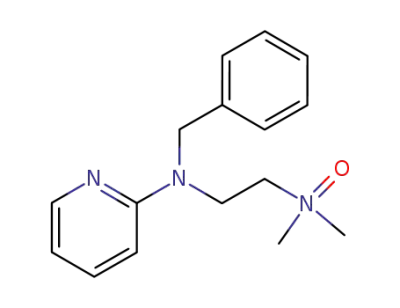
N '-benzyl-N ,N -dimethyl-N '-[2]pyridyl-ethylenediamine-N -oxide
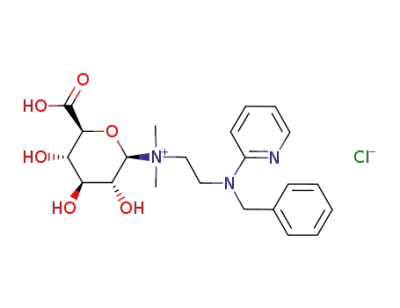
[2-(Benzyl-pyridin-2-yl-amino)-ethyl]-((2R,3R,4S,5S,6S)-6-carboxy-3,4,5-trihydroxy-tetrahydro-pyran-2-yl)-dimethyl-ammonium; chloride